

Hi all,
Following publication of my previous report I received a detailed correspondence from Marcos Lago, the author of the case study published in Frontiers.
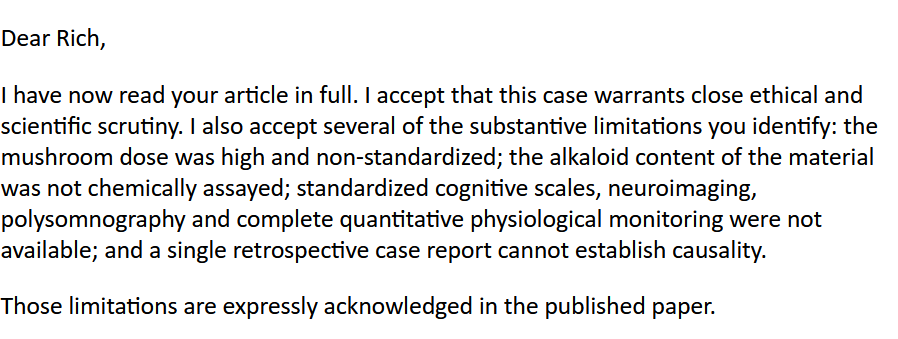
With a view on absolute transparency I am publishing the complete response covering nine key points in my article that Lago has concerns about. I am happy for these kinds of conversations to be out in the open.
I have not edited my original article as I stand by what was written. However, I have removed one detail - a Google street view image of the clinical practice including the property address. I appreciate the request regarding privacy and although the image is publicly available via search engines I don't think it is fair to amplify that aspect of the story.
So here are all responses to my original article.
1: Consent to the clinical intervention
Your article states or implies that an elderly woman with dementia was dosed with psychedelics “without her consent.” That formulation is materially misleading.
The patient lacked decision-making capacity because of advanced dementia. The intervention was expressly authorized by her legal guardian, her son, who was closely involved in her care, participated in the observation and documentation of the case, and is a co-author of the published report.
Written informed consent was also obtained from the legal guardian for publication of the case report.
It is reasonable to criticize the paper for not describing the authorization for the clinical intervention with sufficient detail. The ethics statement distinguished only the written consent for publication, and that brevity has allowed confusion. It is not reasonable, however, to convert that lack of detail into the categorical assertion that the patient was treated without consent.
Please correct the statements suggesting that no consent or authorization existed.
2: Clinical intervention versus prospective research
This was not a registered clinical trial, prospective experimental protocol or recruitment-based research project. There was no research cohort, predetermined outcome schedule, control group, prospective hypothesis-testing procedure or research recruitment.
The clinical events occurred first. The decision to prepare a retrospective case report was made subsequently because the observed changes appeared unusual and potentially relevant.
Retrospective publication does not by itself prove that the original clinical intervention was undertaken primarily to generate scientific knowledge. Nevertheless, I accept that a non-standard intervention followed by scientific publication creates legitimate questions about the boundary between clinical practice and research.
I also acknowledge that the ethics statement in the paper was too compressed. My previous use of the expression “institutional ethics review board” may additionally have created the wrong impression. The Associação Cruz de Ankh has an internal ethics-review and advisory structure. I was not claiming that this structure was a formally registered Brazilian CEP/CONEP committee or an independent academic institutional review board.
The applicability of Brazilian CEP/CONEP procedures to the retrospective publication of this specific case deserves formal clarification. I intend to address that issue directly with the journal and, if appropriate, request an amendment or clarification to the published ethics statement.
This is a more accurate account than suggesting that a newly created association simply approved its own prospective experiment.
3: The Associação Cruz de Ankh
The Association is a legally constituted Brazilian nonprofit religious and philosophical organization. It is relatively new and small. Neither fact establishes scientific fraud, unethical conduct or institutional illegitimacy.
The term “Medical Department” is an internal organizational designation. It was not intended to represent the Association as a hospital, university, accredited clinical-research centre or large medical institution.
The Association’s limited online footprint, the style of its Instagram material, and the fact that administrative or professional activities occur at a small private address have no bearing on whether the clinical observations were accurately reported.
You are free to describe the Association’s size, date of registration and legal classification. Presenting a photograph of a residence as an insinuation that the organization or the report must therefore be disreputable is not a scientific or ethical argument.
4: Regulatory status
I have not claimed that psilocybin is an approved medical treatment for Alzheimer’s disease in Brazil.
The paper is a clinical case description, not a legal opinion or regulatory endorsement. The regulatory treatment of isolated psilocybin and psilocin, whole mushrooms, possession, supply, clinical practice and religious use involves distinct legal questions. Your own article recognizes at least part of this distinction.
You may legitimately question the legal and regulatory basis of the intervention. You should not imply that the paper claimed formal regulatory approval when it did not.
5: Dose and potency
Five grams of Enigma mushroom was a high and non-standardized dose. The published paper explicitly describes it as relatively high and states that no established dosing framework exists for advanced dementia.
However, the material administered was not chemically assayed. Consequently, neither I nor you can state the exact quantity of psilocybin that the patient received.
My reference to approximately 0.6% psilocybin was an explanatory comparison with conventional mushroom estimates and with doses used in previous psilocybin trials. It was not a laboratory measurement of the administered batch.
Your assertion that the material would “easily” have delivered at least 50 mg, followed by the suggestion that the dose was therefore a mistake, is not an established finding. Enigma material may be more potent than conventional cubensis material, but alkaloid concentration varies between cultivations, samples, storage conditions and individual fruiting bodies.
The scientifically accurate formulation is that the actual psilocybin exposure was unknown and may have been substantially higher than conventional estimates. “The potency was not measured” is a valid criticism. “The authors accidentally administered a known 50 mg or greater dose” is speculation.
6: Diagnosis and outcome measurement
The diagnosis of Alzheimer’s disease was based on an approximately ten-year progressive clinical history, including severe memory, language, executive and functional decline. Formal biomarker confirmation and advanced neuroimaging were not available. The paper explicitly states that mixed or alternative neurodegenerative contributions, including vascular disease, could not be fully excluded.
Similarly, the report explicitly acknowledges the absence of standardized cognitive scales and objective neurophysiological measurements. This limits quantification and causal interpretation.
It does not mean that nothing clinically meaningful was observed.
Your description reduces the evidence to a vague observation on the day of treatment and another observation one month later. The report provides a specific chronology: autobiographical speech at approximately 19 hours; changes in alertness and recognition on day 1; mobility, dressing and continence changes on days 2–3; contextual memory, vehicle recognition, eye contact and emotional reciprocity on days 6–7; and continued functional improvement and continence at one month.
These were caregiver and clinician observations, not blinded standardized outcomes. They must be interpreted accordingly. But they should not be represented as though the paper supplied no timeline or follow-up information.
7: Hyperthermia and medical observation
The paper reports “clinically suspected hyperthermia,” not objectively confirmed hyperthermia. Exact quantitative temperature measurements were unavailable, and that is a genuine limitation in the documentation.
Your article changes a suspected clinical observation into a confirmed event and then sarcastically asks whether the medical department owned a thermometer. The absence of a recorded quantitative temperature does not establish the absence of medical supervision or all physiological observation.
I accept the criticism that quantitative vital-sign documentation should have been more complete. I do not accept the unsupported insinuation that the patient was simply left without medical oversight.
8: Paradoxical lucidity
Paradoxical lucidity is a relevant alternative interpretation. The paper does not exclude spontaneous fluctuation, and it expressly states that causality cannot be established.
However, referring to paradoxical lucidity does not settle the case. The observations extended beyond a brief episode of verbal clarity and included continence, ambulation, autonomous dressing, affective responsiveness, initiative and social-contextual functioning over subsequent days and weeks.
It is possible that psilocybin precipitated an episode resembling paradoxical lucidity. It is possible that the temporal association was coincidental. It is also possible that several mechanisms or fluctuations contributed.
A case report cannot adjudicate among these possibilities. Its legitimate purpose is to document an unusual temporal association and generate testable hypotheses. The conclusion of the paper was deliberately limited to that level.
9: Claims of cure and media amplification
I agree that some headlines and social-media summaries exaggerated the findings. I did not write those headlines, and the published paper does not claim that Alzheimer’s disease was cured or reversed.
The conclusion explicitly states that the observation does not imply reversal of Alzheimer’s pathology and that systematic investigation is required.
It is therefore inappropriate to attribute every breathless third-party headline or AI-generated summary to the scientific claims actually made by the authors.
