Let’s start with a story about the wild power of confirmation bias in the world of psychedelics. A story about credulous people and research that affirms their pre-existing beliefs.
In late May a case study was published in Frontiers in Neuroscience telling the story of a woman in her 80s with advanced dementia who was given a big dose of magic mushrooms. The remarkable tale recounts the woman suddenly initiating “autobiographical conversation” hours after the treatment. In the days that followed the authors reported the woman displaying “increased alertness”, “improved mobility, enhanced emotional reciprocity”, and “restoration of urinary continence.”
These improvements apparently persisted for several weeks, and the subject was given a second magic mushroom dose a month later. When revisiting the clinic for this second dose the patient allegedly said, “It is pleasant to come here.”
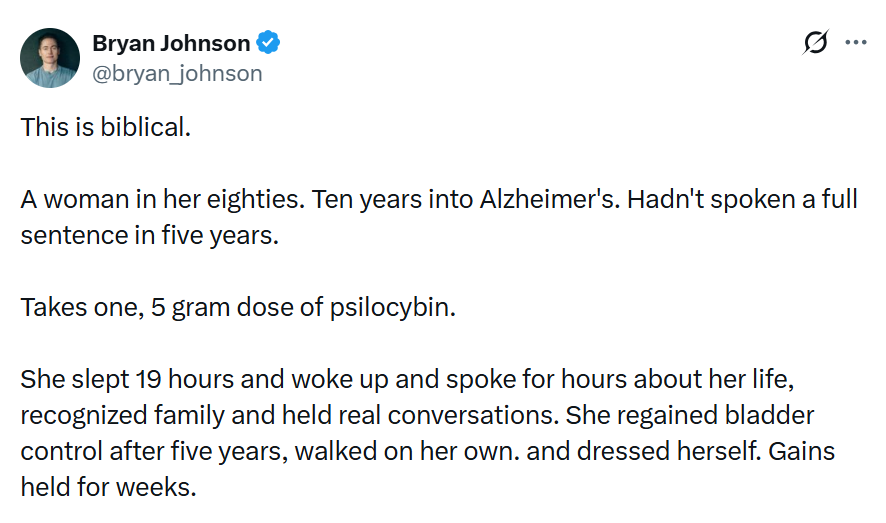
Responding to this case study, the world of psychedelic evangelists did what it does best… Evangelise! And in 2026 the AI-powered social ecosystem churns content fast.
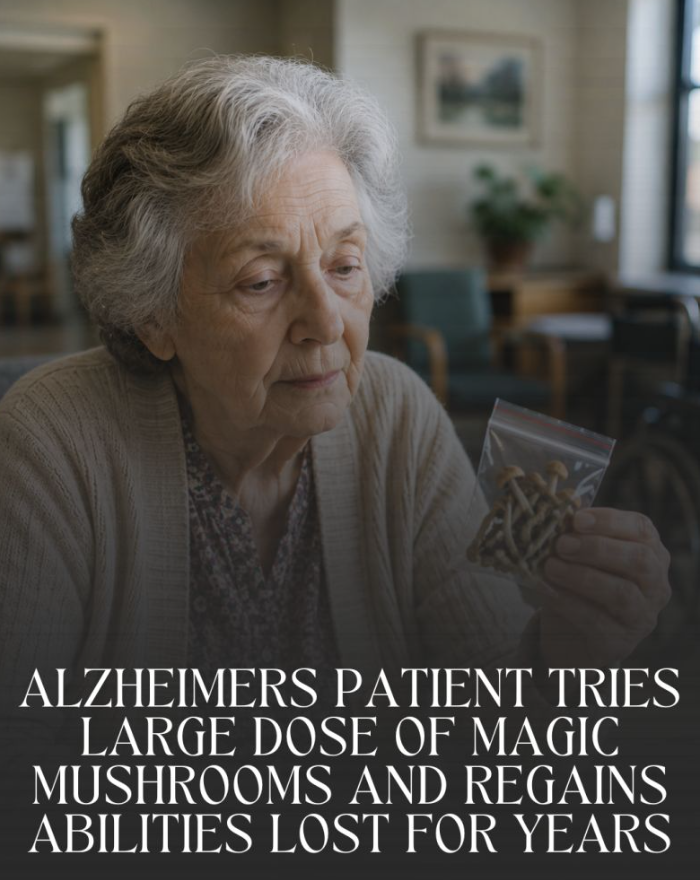
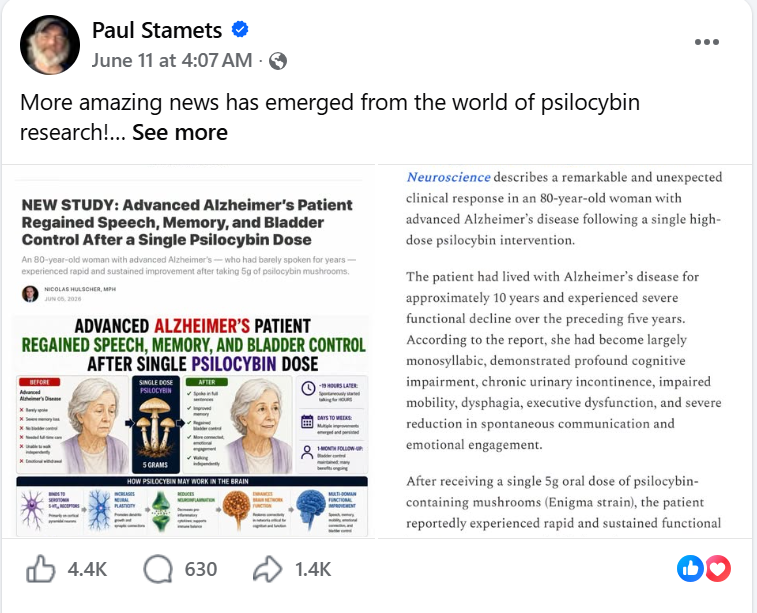
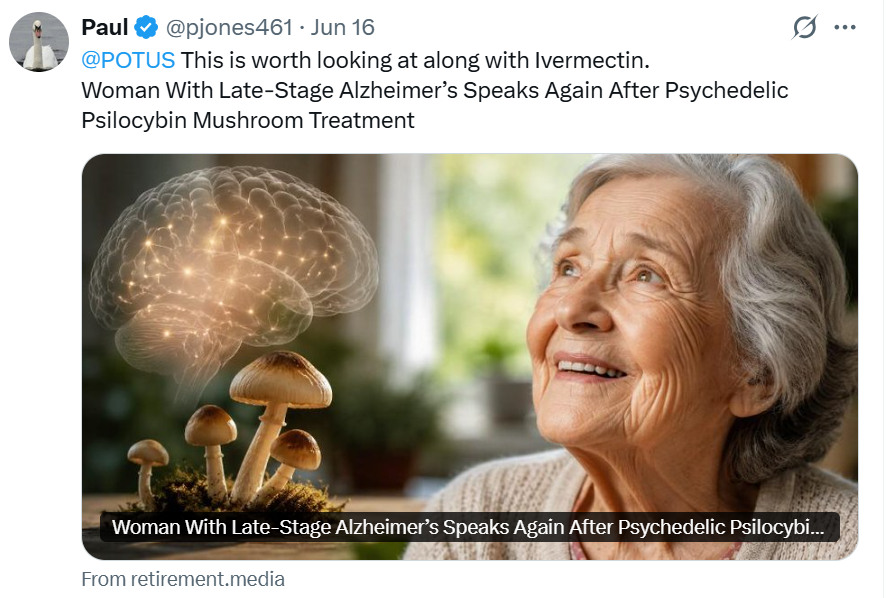
Just a few of the breathless (often AI-assisted) takes on the case study
I initially didn’t pay much attention to this story until a message I received privately homed in on a weird detail in the study. The article noted the dose given to the subject was 5 grams of a type of magic mushroom known as Enigma.
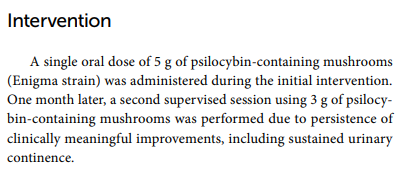
Enigma is a super weird magic mushroom mutant, thought to be the product of human cross-breeding creating a sterile, blob-like, super powered form of the well-known cubensis species. Most relevant to our story is the fact that Enigma is notoriously potent, carrying extraordinarily high volumes of psilocybin.
So 5 grams of Enigma is not a small dose. In fact, if I was being conservative I’d say this volume of mushroom would easily deliver 50 milligrams of psilocybin. To put that dose in perspective, most modern clinical uses of psilocybin focus on 25 milligram doses. Some trial research has pushed up to around 35 or even 40 milligrams, but not much more. Anything higher and you are getting into the territory of doses exclusively left to psychonauts looking to travel across the universe.
Here, we have a very old woman with dementia being given a ridiculously high dose of psilocybin. Surely there were strong ethical guardrails to make sure this was all done with fair oversight? So I started looking more closely at the study.
It didn’t take long to find a few more strange things in the case report.

The case study was barely four pages long and packed with ambiguous statements that handwaved away any comprehensive concerns. The ethics statement, for example, was merely three lines.
And each line raised a whole host of issues.

“Ethical approval was not required for this single case report conducted in routine private clinical practice, in accordance with local legislation and institutional requirements.”
Ethical approval was “not required” here because this was “routine private clinical practice”, but it also was all conducted in accordance with “local legislation and institutional requirements”?
What is the local legislation?
The treatment was conducted in Brazil, a country where psilocybin treatment is most certainly not legal despite mixed messages often presented in the media. Psilocybin is a highly scheduled substance in Brazil, however, the country is notorious for magic mushrooms slipping into a legal grey zone as the actual fungi have not been placed on a restricted list. So growing, and selling, magic mushrooms in Brazil is not currently 'technically' illegal.
What about these "institutional requirements”?
Here, things get a little hazy.
The institution cited in the study is the “Medical Department, Associação Cruz de Ankh, São Paulo, Brazil”. This organisation has virtually no online footprint beyond an extraordinarily active Instagram page populated with AI-generated posts and scores of short monologues by the case report’s lead author, Marcos Lago. These monologues are very much 'life, the universe, and everything'.

The Ankh Cross Association was only formally registered as an organisation in March 2025. Its registration in Brazil was lodged as a “religious or philosophical organisation”, although according to the citation in Frontiers it also apparently has a “medical department”.

The registered address of Association is also the same address of the clinical practice of Marcos Lago, lead author on the case report.
I contacted Lago to ask him for more information about this institution and its role in the active psilocybin treatment of this patient described in the case study. His response:
“Associação Cruz de Ankh is a Brazilian nonprofit organization dedicated to education, support, and research-related initiatives involving consciousness, mental health, and psychedelic-assisted practices. In this case, the association's role was organizational and supportive rather than that of a formal research institution.”
So the association didn't facilitate the psychedelic treatment, and it wasn't "formal research". But who actually gave this patient the drug? Did the patient consent to this treatment? Could they consent? And what kind of ethics board oversight does this institution have?
I contacted one of the reviewers recruited by Frontiers to evaluate the case study and they told me these concerns regarding ethics and patient consent were raised during the review process. These concerns were sent back to the authors and they responded by saying their institution's ethics board had no objections, “regarding the patient's decision-making capacity or the consent process.”
Lago confirmed to me that the Ankh Association does maintain an "institutional ethics review board”. It is unclear who is on that review board. One ethics expert contacted for this story suggested it "unorthodox" for an author of a journal article to also be affiliated with the article's ethics review.
Let’s move on to the second line in that ethics statement.
“No experimental protocol or prospective research procedures were conducted.”
This is an important statement to make in terms of establishing the ethics at play. Research ethics are a different ballgame to clinical practice ethics, and this case study is at pains to stress what is reported here was not “research” but instead a treatment given to a patient as part of “routine clinical practice”.
Olivia Gosseries has written extensively on the complex ethical considerations in using psychedelics on patients with disorders of consciousness. She tells me there can be blurry lines when clinical practice starts to become experimental.
If the primary intent was therapeutic, the regulatory and ethical requirements may differ from those governing a prospective research study. However, once observations are systematically collected and published with the aim of generating scientific knowledge, expectations regarding methodological rigor, transparency, and ethical oversight become considerably higher.
So nothing was being explicitly “tested” in the process of giving this patient such a high dose of magic mushrooms according to the case report authors.
But in that case why engage in such an experimental procedure? There is no pre-existing evidence to suggest giving psilocybin to advanced dementia patients is a useful thing, so to do this in the process of routine clinical practice is questionable. As another ethics researcher told me while I investigated this story, “it’s not something I would run towards [doing]”.
So if this was a case of “let’s give an elderly Alzheimer's patient magic mushrooms and see what happens”, then who consented to this? Here we reach the final line of the ethics statement.
“Written informed consent was obtained from the patient’s legal guardian for the publication of this case report.”
Here the statement again is vague, only making clear consent for “publication of this case report” came from the patient’s legal guardian.
Lago made this statement again to me in our direct communication but no mention was made of the consent process regarding the actual treatment. It can only be assumed that consent for the treatment itself came from the patient’s legal guardian. Lago did explicitly tell me, “Regarding consent, the patient lacked decision-making capacity due to advanced Alzheimer's disease.”
So who gave the patient the mushrooms? How did the treatment even come to pass? How did an 80-something Japanese/American woman with Alzheimer's end up in a tiny clinic in San Paulo being dosed with psychedelics?
All that is unclear. Lago’s involvement in the treatment according to his emails to me state, “I was directly involved in the clinical observation and follow-up of the patient. My co-authors also participated in observation, documentation, and reporting of the case.”
I should add that almost no news article discussing the case study explored or questioned the ethics of this story. Barely any journalists thought to look into the institution behind the case study, or contact the lead author to ask some direct questions.
I could only find one outlet that considered these ethical questions - a newsletter called The Microdose, run out of the UC Berkeley Center for the Science of Psychedelics. Journalist Anna Marie Yanni admirably reached out to a few researchers and received stark responses, critical of the case study.
“This case publication raises several ethical red flags, and violates several of the requirements that make clinical research ethically acceptable,” Dominic Sisti, a medical ethics professor at the University of Pennsylvania told The Microdose on June 9. “What was the purpose and rationale for dosing this particular patient? Was it just out of curiosity that they exposed this woman with dementia to an unknown level of risk?”

Every story amplifying this case study simply pushed out the narrative recounted in the journal. And that’s where we return to the narrative in the journal itself. Setting aside any questions around how and why people were dosing a very old dementia patient without their consent, what was actually reported in the journal was sketchy at best.
Regarding the dose, for example, it seems the authors of the article were not particularly well-informed as to the unusual potency of Engima type of magic mushroom. When I asked Lago what was behind the dose choice in this particular treatment he responded:
“With respect to dosing, there is currently no established dosing framework for advanced Alzheimer's disease. The 5 g dose was not based on prior efficacy data in this population, as such data do not presently exist. The decision was informed by existing knowledge regarding psilocybin-containing mushrooms and by practical considerations within the private clinical context in which the intervention occurred. In the Johns Hopkins and Imperial College trials, 30mg of psilocybin were tested. That is equivalent of 5g of mushrooms containing 0,6% of psilocybin.”
So the potency of the dose given to the patient in this case study was a mistake? They were only intending to give something along the lines of standard dosing, shooting for maybe 30 to 35 milligrams of psilocybin?
Traditional lines of cubensis mushrooms do indeed generally contain 0.6% of psilocybin, however Engima often delivers between 1% and 2% psilocybin.

Other unorthodox aspects in this case study are the lack of any objective clinical diagnostics to determine whether the patient had Alzheimer’s Disease in the first place. No actual formal outcome measures were properly tracked here either.
To be fair the final published article does note there was an “absence of formal polysomnographic monitoring, quantitative electrophysiology, neuroimaging biomarkers, and standardized cognitive scales.” But what is ultimately reported leaves us with a pretty vague “day of” and “month later” observation, alongside any feedback from the patient’s carer.
As Olivia Gosseries tells me:
While the observations are certainly of interest, the absence of validated questionnaires, systematic behavioral measurements before and after treatment, and objective outcome measures makes it challenging to quantify the reported changes. As a result, it remains difficult to assess the extent to which the observed improvements may be related to the intervention itself, as opposed to spontaneous fluctuations, concomitant treatments, observer expectations, or other factors that may have contributed to the clinical evolution."
Even more stark is the lack of medical oversight during the dose. The report cites the patient suffering from clinically suspected hyperthermia and profuse sweating after being given the magic mushrooms. But, “exact quantitative temperature measurements were not available.”
So the medical department of the Associação Cruz de Ankh doesn’t even carry a thermometer to take a patient’s temperature? I won’t even ask about blood pressure or heart rate abnormalities that may have occurred during the high dose psilocybin treatment in a medically fragile octogenarian.
Overall, even the big takeaway from the study may not be particularly novel.
The authors conclude the findings don't indicate psilocybin reverses Alzheimer's (even though that is the angle most coverage of this story ran with) but rather they suggest this story raises, "the possibility that latent functional capacities may persist in advanced neurodegeneration and become temporarily accessible under specific neuromodulatory conditions."
A fine conclusion I guess, except when I spoke to some experts who investigate dementia I was told this finding wasn't new news. One researcher explained to me this was a good example of a common phenomenon called ‘paradoxical lucidity’.
This is a strange, and understudied, phenomenon where advanced dementia patients spontaneously encounter extended periods of unusual lucidity. These periods can be short, lasting just minutes, or they can extend to hours. Patients suddenly spark back to cognitive life, engaging in conversations with loved ones after years of monosyllabic communication.
We don't know what triggers these periods, and they often occur in patients as they near the end of their life. So maybe psilocybin triggered a period of paradoxical lucidity in this elderly patient? If it did the event itself wouldn't be especially novel. And without any good insight into what changed or how long it changed for we don't get a great deal of information out of this case study.
And here I end up, writing more than 2500 words on questions around an odd outlier of a case study that has been uncritically heralded as evidence of the magical healing power of psychedelics.
A journal article crunched up into an AI summary that spread across social media like wildfire and fed into all the evangelical dreams of those who already believe psychedelics are the solution to all our problems.
Welcome to Trip Reports. Please subscribe for future dispatches. I don’t think they’ll all be this long, and some will be more fun.
Thanks for reading.
Editor's Note: 25/06/2026


