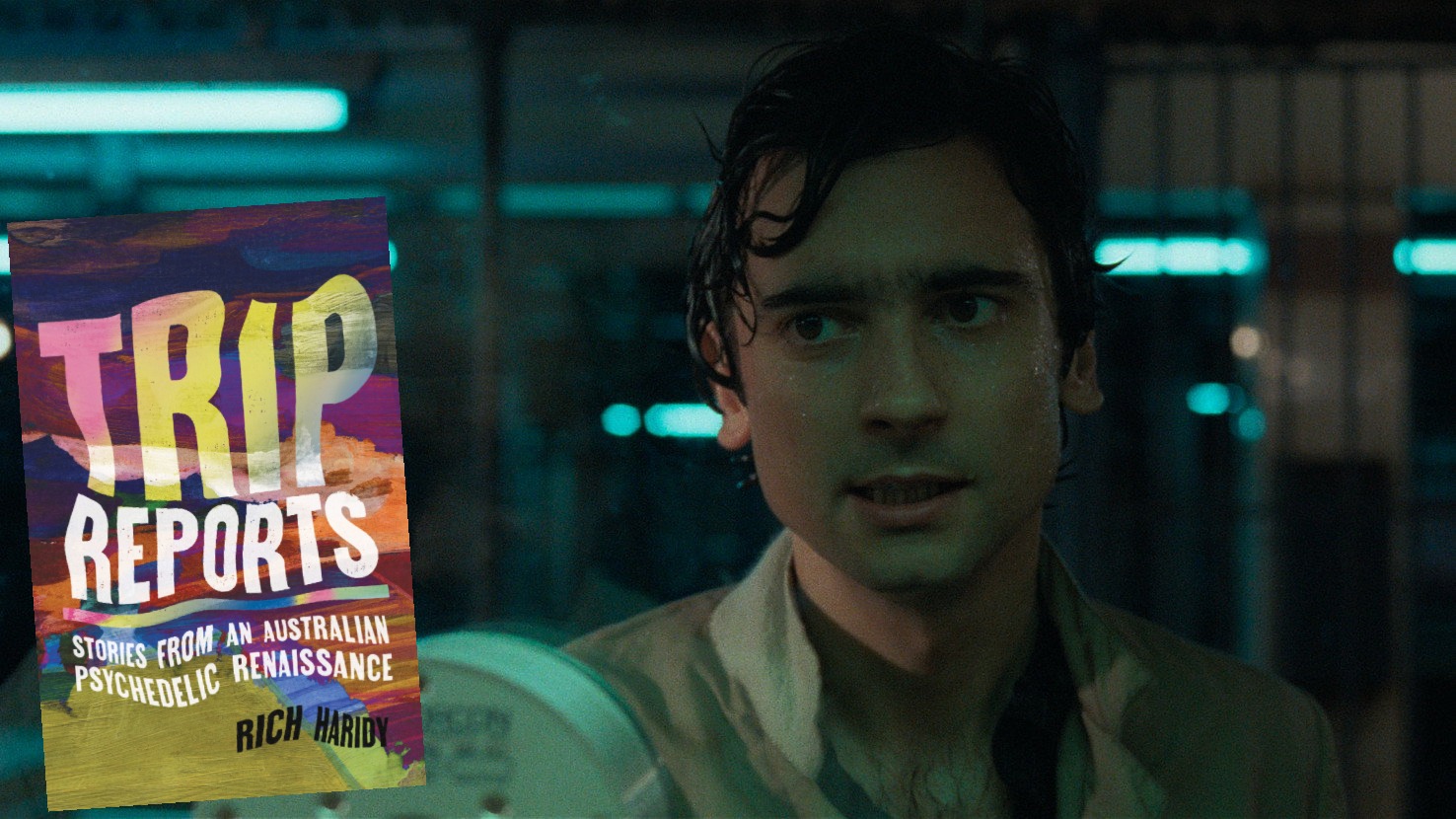

Well, here we go. The book should be out in the world very soon so I thought I’d pull a bunch of things into one big dispatch. At the bottom of this piece you’ll find details on three launch events we have planned, plus a few more endorsements.
But first, I want to share a rundown of a piece I had published in the Sydney Morning Herald over the weekend. Then I’ll give you the official ‘Trip Reports’ movie list. These are nine movies that I think reflect some ideas that come up in the book. They’re also nine brilliant flicks that you should watch regardless.
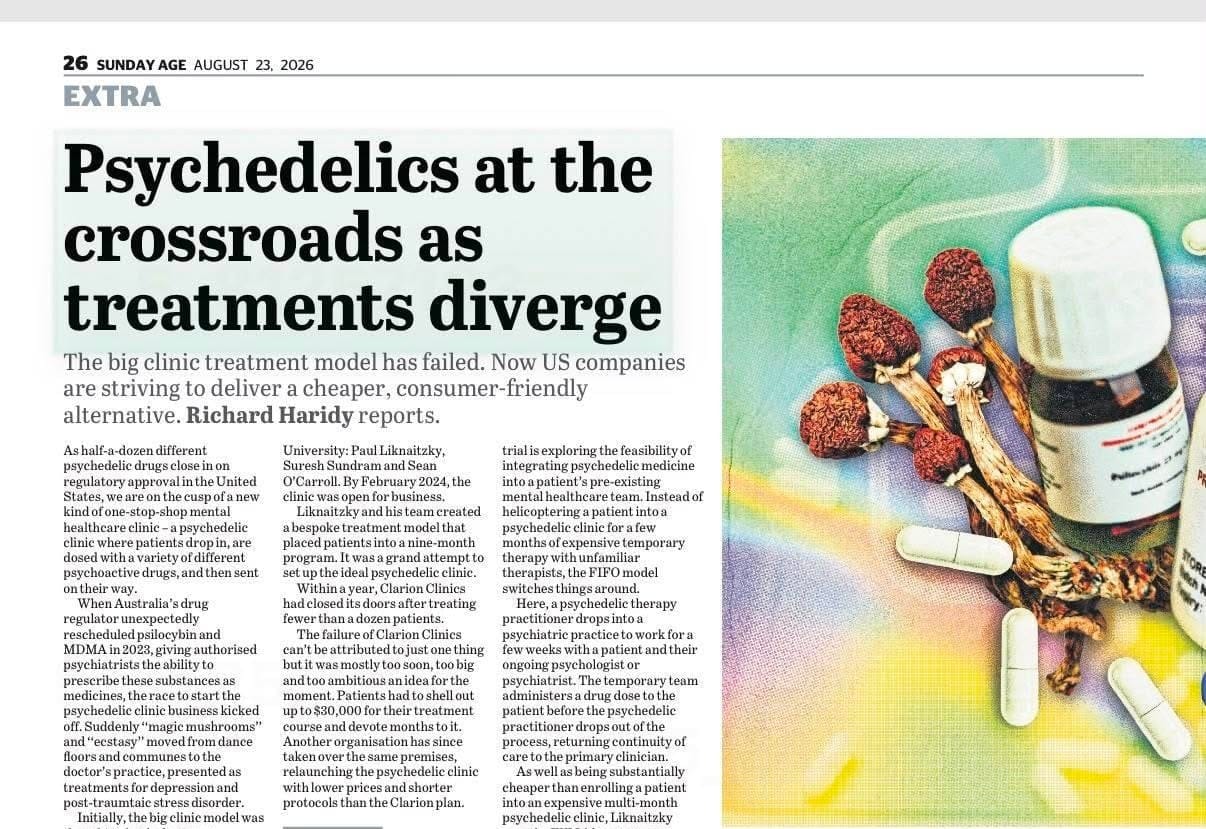
The article published on the weekend turned into a bit of a Frankenstein story. Initially conceived as an edited extract from the book, it ultimately became a mostly new, stand-alone feature with original reporting. The idea that sparked interest from the paper's editor was a chat we had about the way several clinicians and researchers in Australia shifted their practice over the past couple of years following real-world experiences with psychedelic medicine.
I wanted to start a bit of a conversation about how we should be deploying psychedelics into our current health care systems; and whether the early learnings in Australia are pointing in certain directions.
The original draft of the article was much longer than what was published so I thought I'd share with you an excerpt from that early version. After spending a year writing a book - with no word limits or constraints - I've likely slipped into a style of waffle writing that needs to be paired back. But here, for posterity, is the first draft of the opening stretch.
 Richard Haridy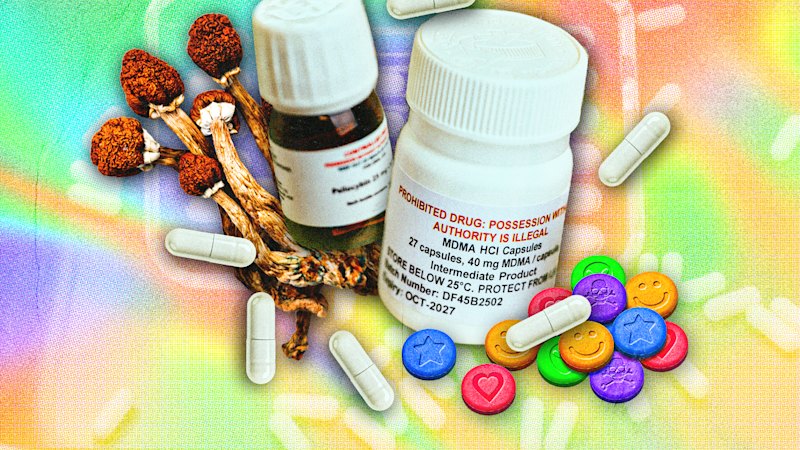
Psychedelics are big business in 2026.
In July pharmaceutical giant Eli Lilly spent several billion dollars acquiring a small company developing short-acting psychedelics signalling a new seriousness to the burgeoning industry. Despite more than two decades of clinical development no psychedelic drug has yet to be formally approved as a medicine.
But that may change very soon.
Half a dozen different psychedelic drugs are currently closing in on approvals in the United States and the end goal is establishing a new kind of one-stop shop mental health clinic - a psychedelic clinic where patients drop in, are dosed with a variety of different psychoactive drugs, and then sent on their way.
For several years advocates of psychedelic medicine such as Rick Doblin have pushed the idea that psychedelic clinics are coming.
They’ll be big, and everywhere.
When Australia’s drug regulator unexpectedly rescheduled psilocybin and MDMA in 2023 giving authorised psychiatrists the ability to prescribe these substances as medicines the race to start the psychedelic clinic business kicked off. However, three years into this country’s unique experiment there is a growing sentiment among researchers and clinicians questioning whether the big clinic model is really the best way forward. Australia’s cautious exploration into how these drugs can transition into real-world medical practice is generating some novel insights that the rest of the world can pay attention to.
A few months after the Therapeutic Goods Administration’s rescheduling announcement came the first clinic reveal. In May 2023 cannabis pharmaceutical company Incannex revealed it was launching Australia's first dedicated, purpose-built psychedelic clinic.
Set on the banks of Melbourne’s Yarra River in the leafy inner suburb of Abbotsford, the space was named Clarion Clinics. Designed as a commercial-scale prototype the clinic promised to treat up to 600 patients a year. Co-founding the whole enterprise was a team from the Clinical Psychedelic Lab at Monash University: Paul Liknaitzky, Suresh Sundram and Sean O’Carroll.
By February 2024 the clinic was open for business.
Liknaitzky and his team created a bespoke treatment model that placed patients into a nine-month program based on all the learnings from their clinical trial work. It was a grand attempt to set up the ideal psychedelic clinic.
And within a year Clarion Clinics had closed its doors after treating less than a dozen patients.
The 'Trip Reports' Movie Club
The films you need to see before, or after, you read the book.
Here are three 'triple-features' that reflect some ideas I grapple with in the book.
I don't want to load you up with pre-existing frames for viewing these movies so I'll be a little obtuse in how I suggest these movies talk to the book. In fact, feel free to email, message, or comment if you want to dig into any connections you feel may emerge.
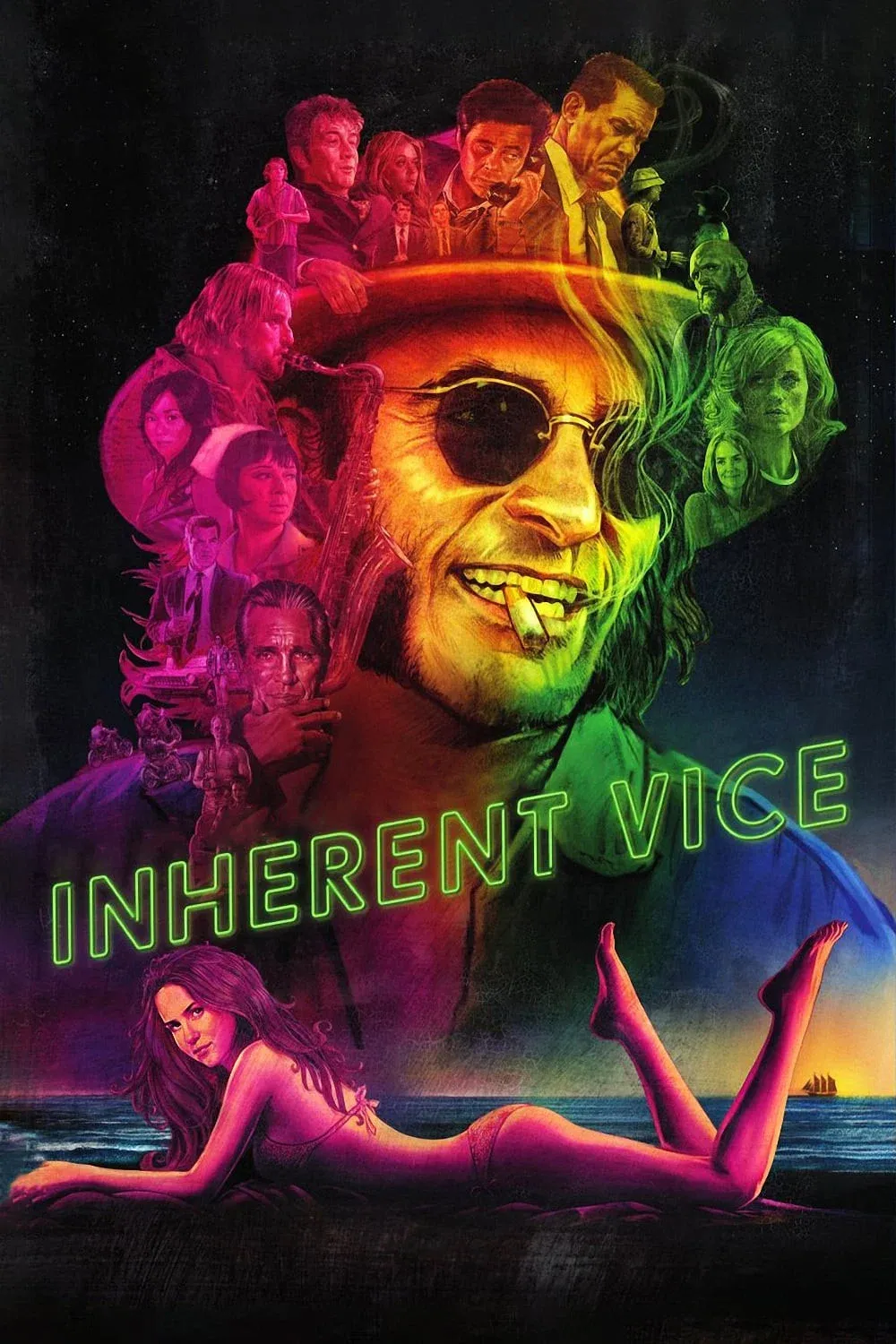
The death of 'us' and the birth of 'me'
Psychedelic culture, and psychedelic medicine, in the 2020s is deeply solipsistic. We use the drugs to 'find our true self'. We put on eye masks and headphones. We travel inwards for self-improvement.
So how did we get here?
These three movies cover a trio of cultural shifts that take us into the 21st century.
'Inherent Vice' tells the story of how the smog of capitalism and corporatisation engulfed the 50s and 60s. It's gorgeously confusing.
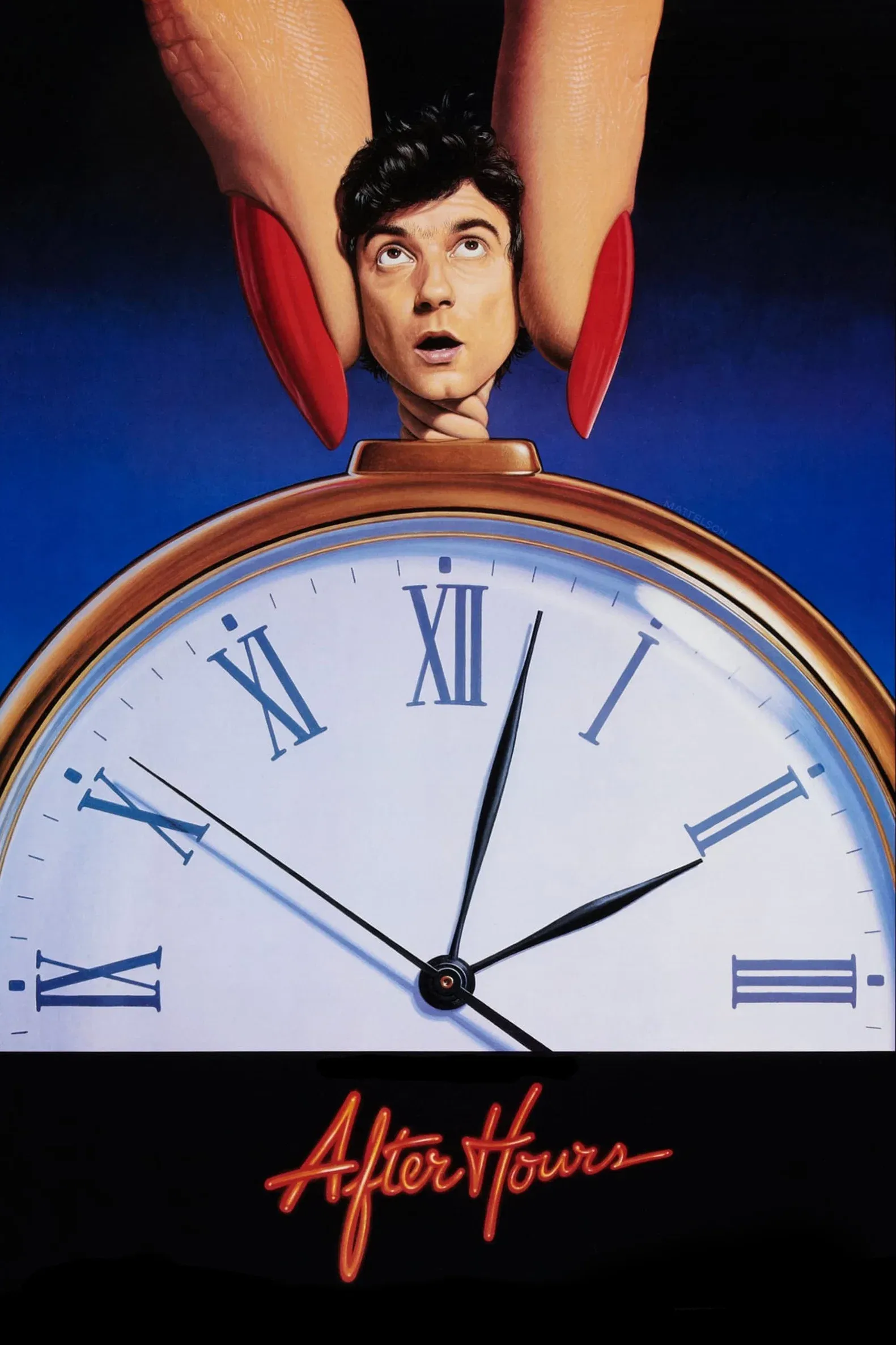
'After Hours' shows us what happens when 1980s yuppie culture meets the last remnants of communal society. It's a nightmare comedy where community is presented as the biggest threat to individualism.
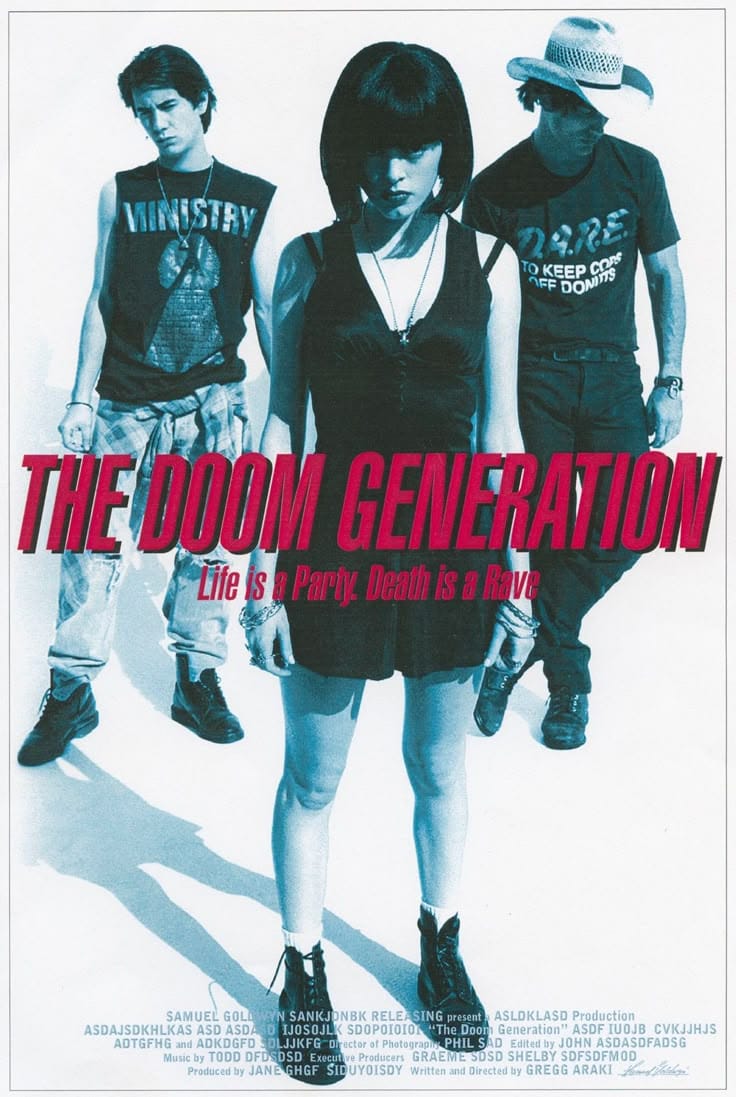
'The Doom Generation' presents the apathy of Gen X in the 90s before digital technology destroyed the last vestiges of connection. Nostalgia for shared nihilism.
Who is you?
If the first trio of movies looked at the big cultural shift toward individualism over the past 50 years then this next triple looks at the granular way we make our identity. Here are three very psychedelic films that perfectly encapsulate how our identity is constructed, and performed.
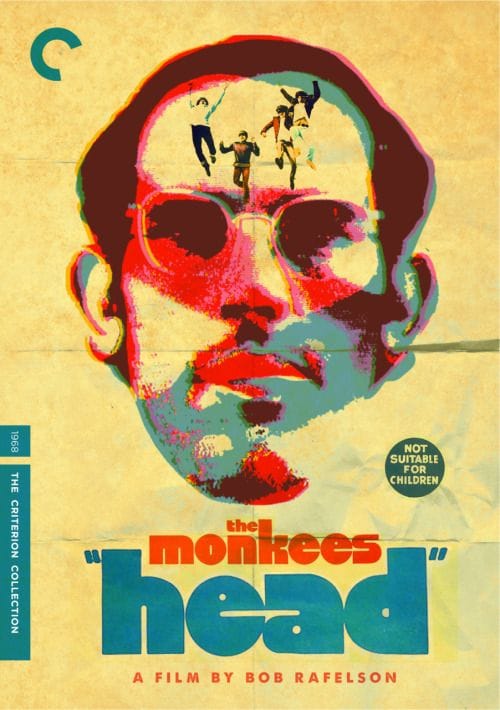
'Head' is perhaps my favourite 'psychedelic' movie. Wildly subversive. It ends with the director literally capturing the personas of the band and driving away.
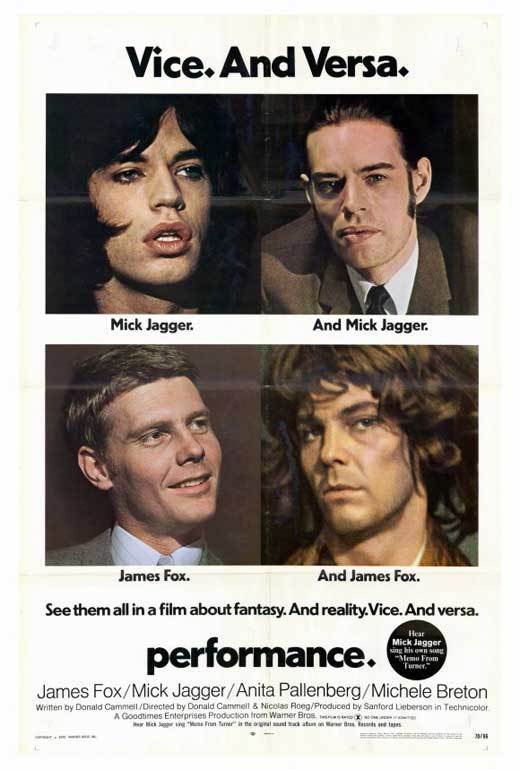
'Performance' is a beautiful time capsule of a moment where the psychedelic generation turned to look at the squares and ask, 'Who is playing who?'.
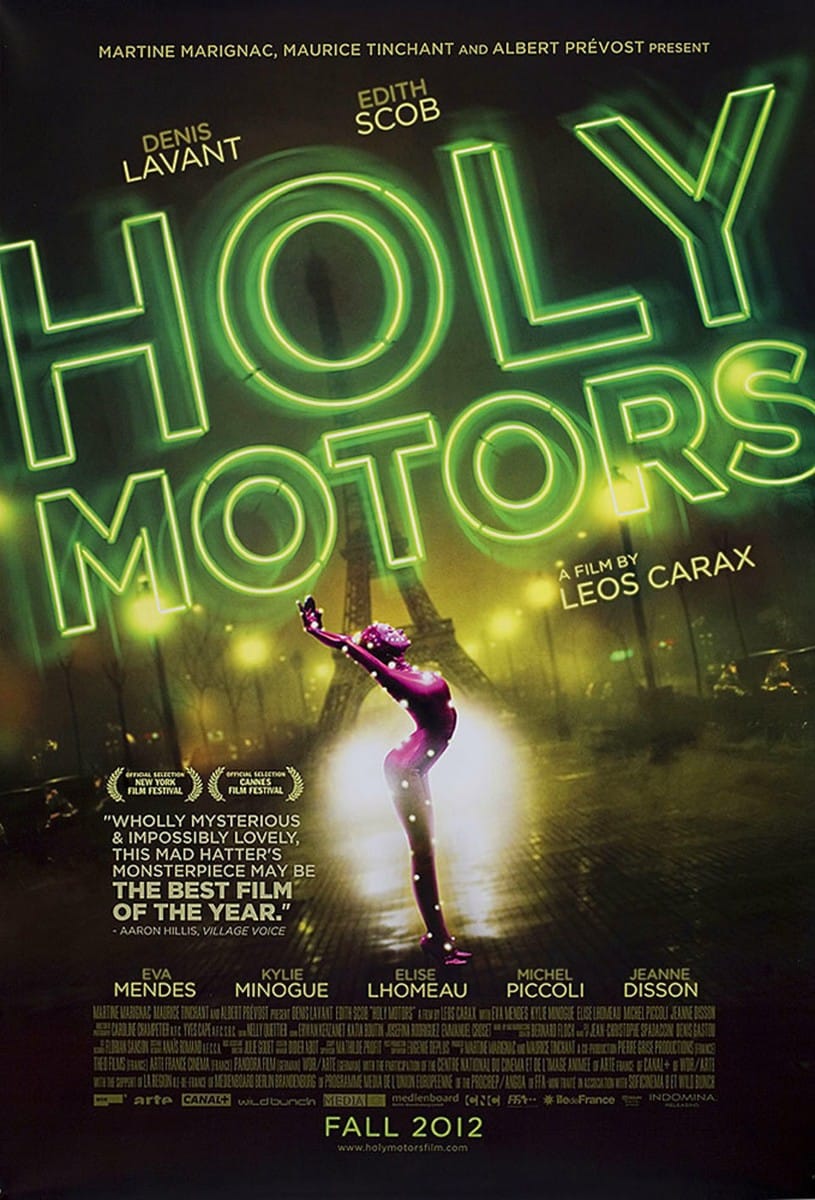
'Holy Motors' captures, perhaps better than any other film, how fluid our modern self is. If many use psychedelics to find their 'true self', then this film asks whether there is a true self to be found?
Ecosystems of isolation
So this is where we end up. The consequence of a world focused on individualism. Isolation, paranoia and monomania. These three films are all vibes. This is where we are. This is who we are.
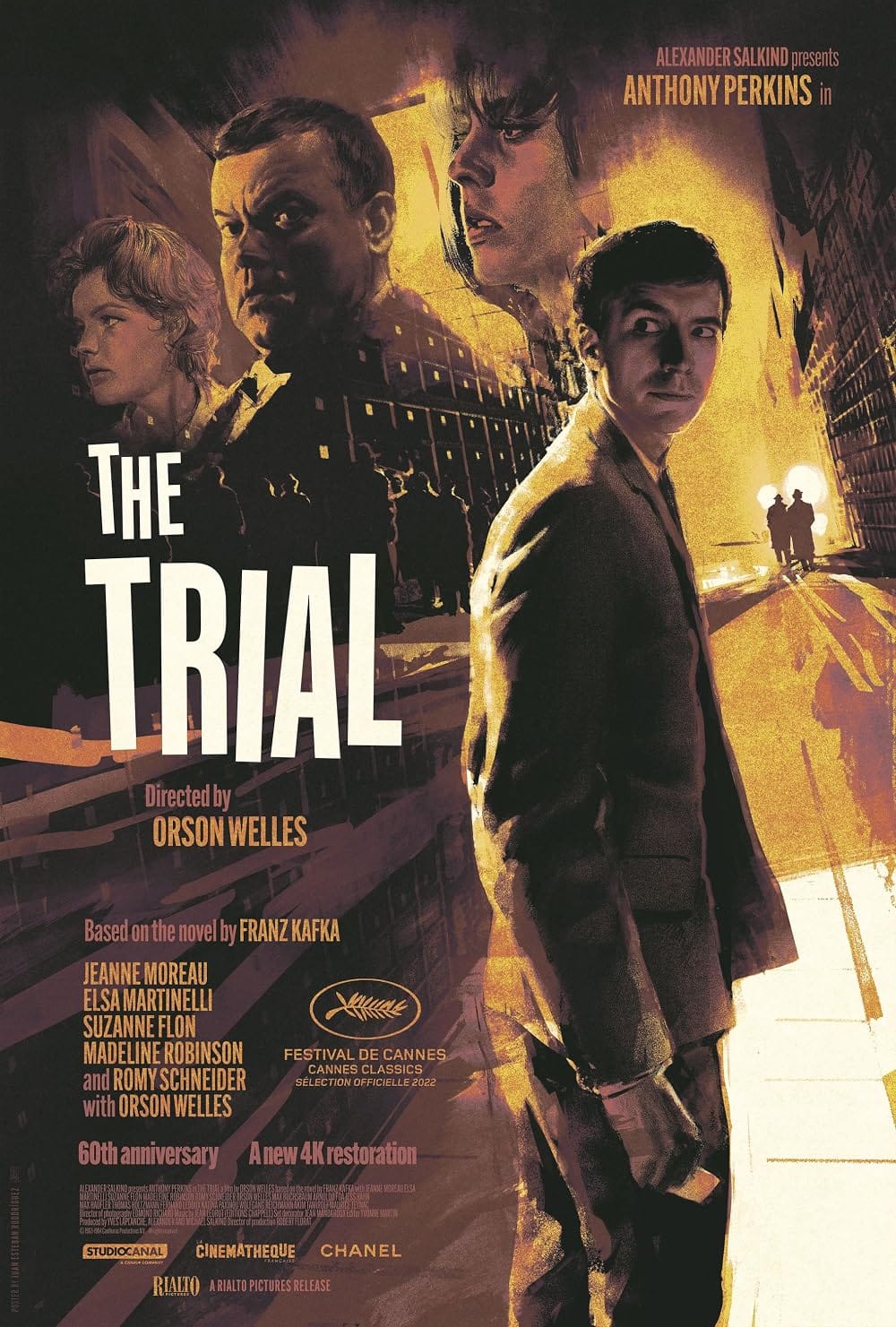
'The Trial' is my favourite Welles, and the best Kafka adaptation. It was prescient in the 1960s and it is pretty much a documentary today.
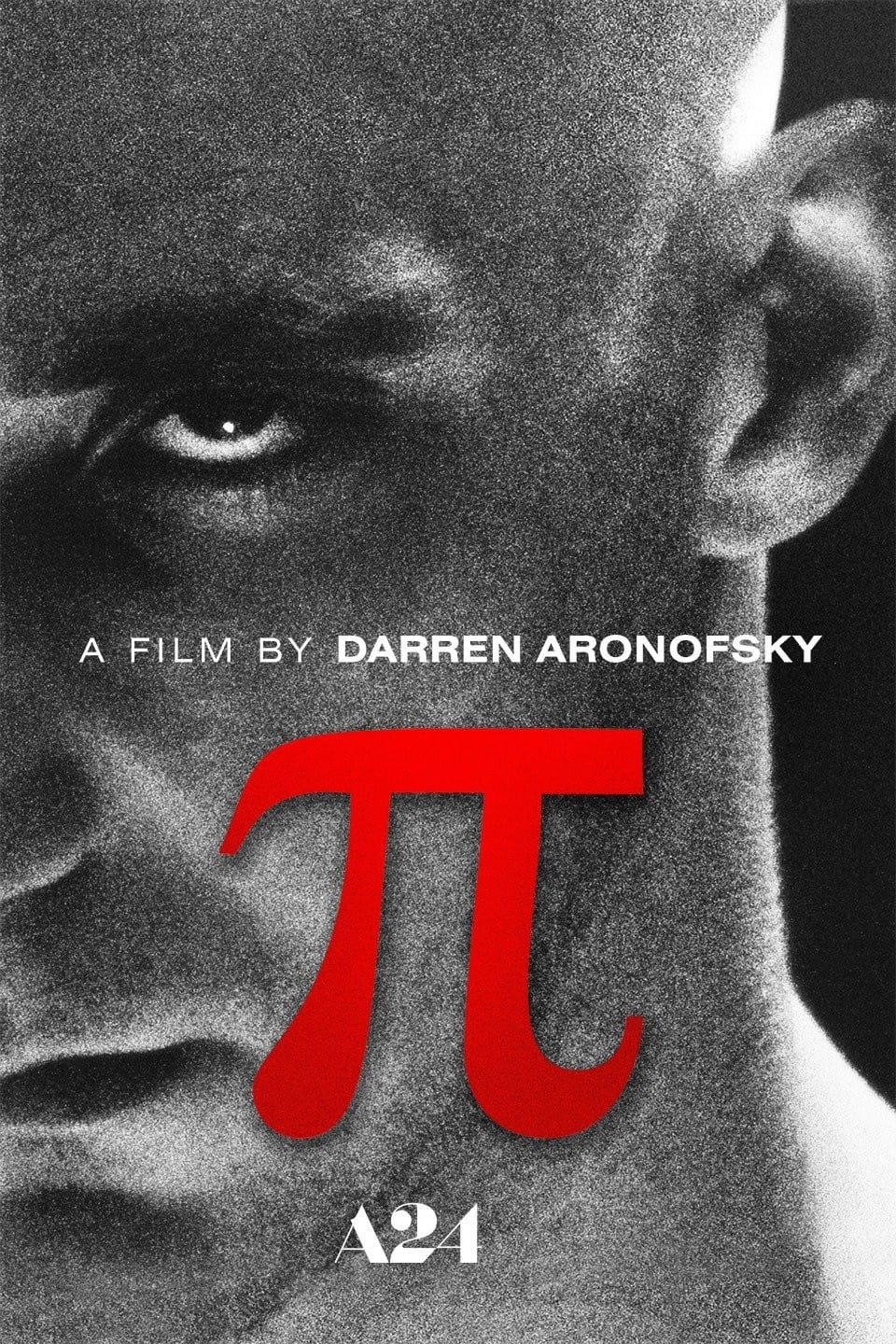
'Pi' was a nightmare in the late 90s but watched today reads like a perfect allegory for our need to fix our broken brains. The drill to the brain scene is a metaphor for modern psychedelic medicine.
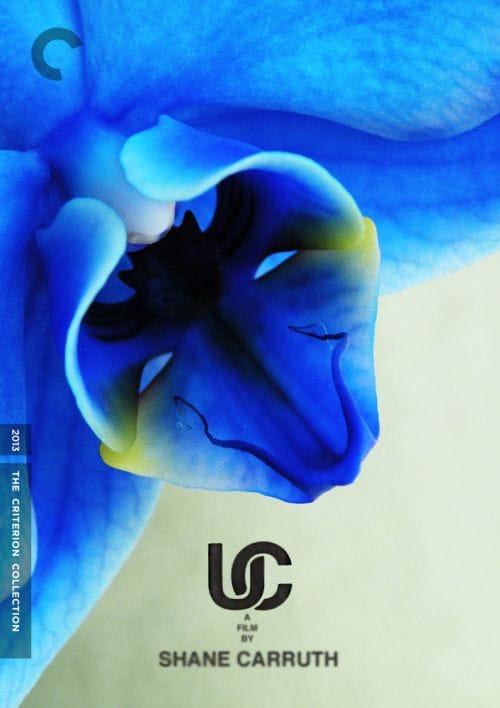
'Upstream Color' is as close as you get in film to conveying the feeling of connection psychedelics often generate. This is melancholy but hopeful.
The blurbs
Where people more talented than me say positive things about my work.
Bear with me. I'm taking the humble part out of the humblebrag and frankly saying, 'This is incredible'. Here are four blurbs from four incredible people who read my book and liked it (or at least pretended to like it, which I'll take!).
‘Like the internet revolution, the psychedelic renaissance is just a story: a narrative that is being co-opted by capitalism, individualism and pharmaceutical imperialism. It’s not too late to retrieve the humanising potential of these substances, but we must begin by taking account of what’s really happening here. Rich Haridy combines the rigour of a true journalist with the epistemic modesty of an intellectual in an engaging and necessary read for anyone who hopes for psychedelics to remain truly transformational.’
Douglas Rushkoff, Team Human
‘Trip Reports is a mind-expanding journey through Australia’s unique and little-known history of psychedelic discovery and its current world-leading therapeutic initiatives. Across its deeply informed, lucid and highly readable narrative, Rich Haridy untangles the mysteries and debates that range across the spectrum from plant evolution to pharmacology to mental health. His conclusions challenge the currently hyped model of therapy and point towards radical new horizons.’
Mike Jay, author of Psychonauts: Drugs and the Making of the Modern Mind
'A cool, exacting look at psychedelics that cuts through the noise to bring clarity and nuance to a rapidly evolving field.’
Alison Pouliot, author of Underground Lovers: Encounters with fungi and Wild Mushrooming
'An intelligently critical and up-to-date discussion of the psychedelic field. Trip Reports is an even-handed and evidence-based exploration of psychedelics and their potential, while avoiding the hype.’
Lynne Malcolm, author of All in the Mind
Launch events
Melbourne, Sydney, Castlemaine
Melbourne, September 10th, Readings
On Thursday September 10th I'll have my hometown launch at the best bookshop in the world, Readings Carlton.
The brilliant Belinda Smith, co-host of ABC Radio National's The Science Show, will be joining me for a short conversation.
This one is free but book at the link below. Please come and be friendly.


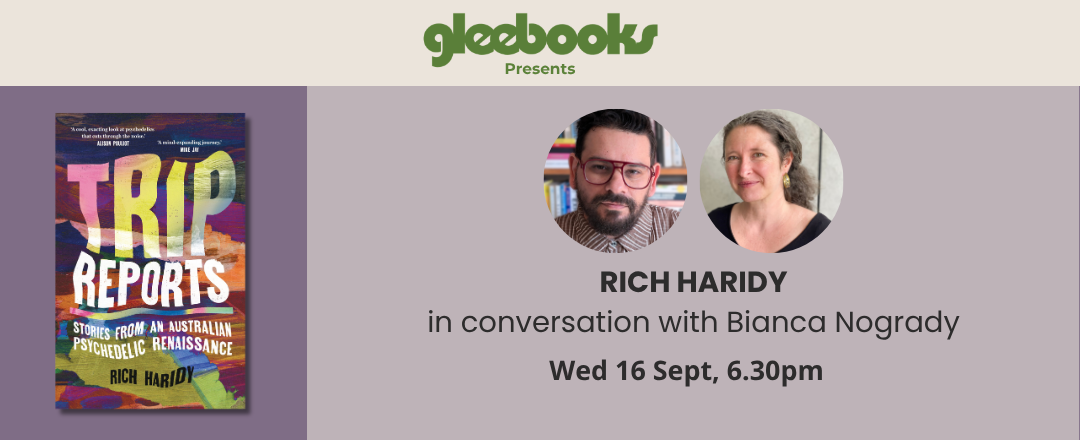
Sydney, September 16th, Gleebooks
On Wednesday September 16th I'll be in the surf town of Sydney having a conversation with the legendary science journalist Bianca Nogrady.
This one is at Gleebooks in Glebe, which from all accounts looks to be a super cool bookshop that massively supports local authors and publishers.
This one is ticketed but you can grab a book with a ticket if you haven't already pre-ordered. I will scribble something in it on the night too, if you're into that kind of thing.

Castlemaine, September 24th, Theatre Royal
OK, this is a special one for the real heads.
We're doing a special screening of 'After Hours', preceded by a short Q&A between me and Monica Barratt from the Australian Psychedelic Society.
The movie is great, there'll be friends, food and drinks. I'm really looking forward to this one guys. If you are anywhere in the vicinity you should come.